
Building a Sustainable Nelson Mandela Bay: A Coffee Morning at Coega Biomass Centre

One group of guests touring the Coega Biomass Centre production facility.
What happens when invasive alien trees are cleared from the Eastern Cape? At Coega Biomass Centre, they become fuel for South African industry.
On Wednesday, 14 October, we opened our doors for a Coffee Morning hosted in collaboration with the Nelson Mandela Bay Business Chamber. Under the theme "Building a Sustainable Nelson Mandela Bay", local business representatives came together to explore how environmental restoration, renewable energy and industrial manufacturing can support one another.
The morning brought together four speakers, a tour of our wood pellet production facility and a live demonstration of a former paraffin boiler running on biomass.
From environmental challenges to practical solutions
Dr Gary Koekemoer of WESSA Eastern Cape opened the programme by discussing climate change and what it means for Nelson Mandela Bay. His presentation set the scene for the morning: the region faces environmental challenges that require action from businesses as well as communities.
Edith Mshoperi, Impact Lead at Stewards of Nature, then brought the discussion to the Eastern Cape's landscapes.
Invasive alien trees consume large quantities of water and threaten indigenous ecosystems. Stewards of Nature works to restore affected areas by removing these trees, helping improve water availability, supporting biodiversity and creating local employment.
The cleared wood also has a practical use.
At Coega Biomass Centre, more than 90% of our wood feedstock comes from invasive alien trees. The wood is chipped, dried and compressed into uniform 8 mm pellets, creating a renewable fuel that manufacturers can use to produce steam and industrial heat.
With an annual production capacity of 120,000 tonnes, Coega Biomass Centre is Africa's largest wood pellet producer, supplying customers in South Africa, Europe and Asia.
Making the switch to biomass work for local industry
Our Commercial Director, Cas Snijders, continued the story by addressing a question facing many South African manufacturers: how can businesses reduce their dependence on fossil fuels without compromising their operations?
Industrial boilers commonly run on diesel, paraffin or heavy fuel oil. These fuels expose businesses to international oil price fluctuations, exchange rates and increasing carbon tax costs.
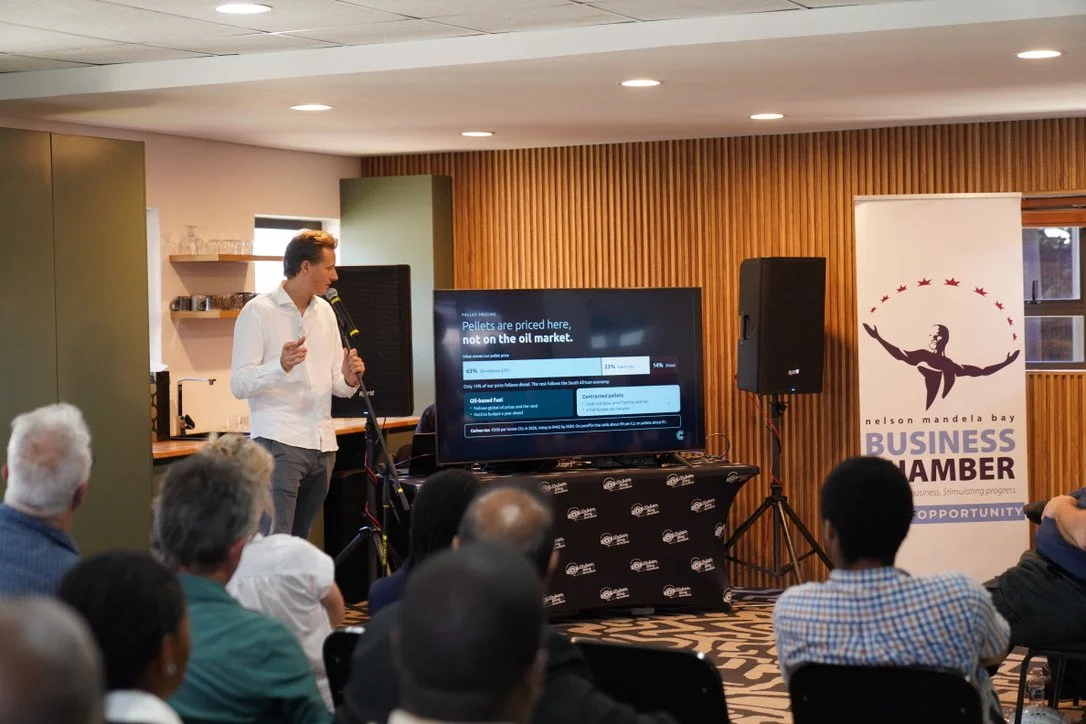
Our Commercial Director Cas Snijders presenting the benefits of biomass for South African industry.
The environmental benefits are significant. According to our lifecycle greenhouse gas assessment, CBC's wood pellets produce approximately 80% lower lifecycle emissions than diesel, paraffin or heavy fuel oil.
But making the fuel available was only part of the challenge.
Many businesses interested in switching to biomass already have boilers designed for liquid fossil fuels. Replacing an entire boiler system can be expensive, while arranging a separate engineering conversion creates additional work and uncertainty.
This challenge led to the establishment of Cape Carbon, a joint venture between Coega Biomass Centre and DreamTech Engineering.
Cape Carbon converts existing industrial boilers to run on wood pellets and provides the ongoing fuel supply under one contract. Its locally designed EcoFlame burner makes the technology accessible to manufacturers looking for a practical alternative to fossil-fuelled industrial heat.
Seeing the process in action
Following the presentations, guests had the opportunity to see the full process for themselves.
A guided tour took visitors through our production facility, following the journey from raw wood to finished pellets.
The tour continued in the Cape Carbon boiler room, where visitors saw a boiler originally designed to run on paraffin operating on wood pellets.
For manufacturers considering a similar conversion, the demonstration offered a practical look at how existing industrial heating equipment can be adapted to use locally produced biomass.

Visitors get a closer look at Cape Carbon’s in-house built EcoFlame burner, converting a former paraffin boiler to run on wood pellets.
Sustainable manufacturing in practice
The morning also included a presentation by Andre Adendorff, Sustainability Manager at Woodlands Dairy.
He shared how the company has replaced almost all of its heavy fuel oil consumption with biomass, reducing its dependence on fossil fuels and its carbon footprint while contributing to cleaner air for surrounding communities.
Woodlands Dairy's experience provided an example of what industrial fuel switching can look like beyond the demonstration stage.
Building a sustainable Nelson Mandela Bay
Throughout the morning, one connection became clear: the wood removed to restore the Eastern Cape's landscapes can also help power its industries.
From recovering water resources and creating employment through invasive alien plant clearing, to manufacturing renewable fuel and converting industrial boilers, each part of the process contributes to a more sustainable local economy.
Our thanks to the Nelson Mandela Bay Business Chamber, Dr Gary Koekemoer, Edith Mshoperi, Andre Adendorff and everyone who joined us.
We look forward to continuing the conversation with local businesses about the opportunities for biomass in South African industry.